Chapter Eleven, Part II
- Elio Castellan
- Aug 10
- 6 min read
Updated: Aug 10
The Wrong City
By the time Adrian reports for duty the following morning, Jack has sent him the train details, the hotel name and a map marked with the station where he will be waiting.
The final message says:
Do not miss the stop.
Adrian looks at it for a moment before replying.
I know exactly where I’m going.
I navigate aircraft cabins professionally. I believe I can manage a platform.
Jack answers several minutes later.
You walked into a workshop looking for a bottle opener.
Adrian puts the phone away before briefing.
For the rest of the duty, he has little time to think.
The flight is full. There are special meals missing, a passenger who insists his seat is broken when it is not, a medical concern halfway across Greenland that resolves without a diversion, and enough small operational decisions to keep Adrian moving almost constantly.
He is grateful for it.
Work gives him structure. It keeps the distance measurable.
Hours. Services. Paperwork. Descent.
By the time the first pale light appears beyond the windows, his body has lost any clear understanding of what time it is.
Locally, it is morning. At home, it is late afternoon. In Los Angeles, Jack will have been awake for hours.
The aircraft lands in San Francisco shortly before seven.
Adrian switches on his phone while the last passengers are still collecting their belongings. A message from Jack is waiting.
Morning. Hotel. Food. Shower. Sleep.
Adrian reads it twice.
There is no greeting beyond the single word. No question about whether the flight went well. Jack knows it was work. He knows Adrian will be exhausted.
The directness should irritate him.
Instead, it feels like being looked after.
He replies: Landed. Still alive.
The answer appears before he reaches the crew bus.
Good. Keep it that way.
They reach the crew hotel shortly after eight.
Adrian exchanges the usual tired remarks with his colleagues in the lobby, collects his key, and avoids answering when one of them asks whether he has plans for the afternoon.
He has learned that cabin crew can turn a moment’s hesitation into a full investigation.
In his room, he removes his uniform, hangs it carefully, and orders toast, eggs, and coffee from room service. He eats more from discipline than hunger, then showers and closes the curtains.
He sets his alarm for twelve fifteen.
One final message to Jack. In bed. Alarm set.
Jack replies: Sleep.
Adrian places the phone facedown beside him.
For several minutes, his body refuses to settle. The room is unfamiliar, the air-conditioning too loud, and his mind keeps producing details about connections, stations, and the possibility that he will wake too late.
Then he thinks of Jack waiting at the other end of the journey.
He falls asleep.
The phone vibrates beside his head.
Adrian reaches for it without opening his eyes. “Hello?”
“You awake?”
Jack.
Adrian turns onto his back and looks toward the clock.
Twelve nineteen.
“I am now.”
“You missed the alarm.”
“By four minutes.”
“I was giving you five.”
Adrian rubs a hand over his face.
“Have you eaten?” Jack asks.
“I did before I slept.”
“Take something with you.”
“Yes, Dad.”
The silence at the other end lasts just long enough for Adrian to realise what he has said.
Then Jack laughs. “Get dressed.”
The call ends before Adrian can respond.
He lies there for a moment, smiling despite the exhaustion.
Then he gets up.
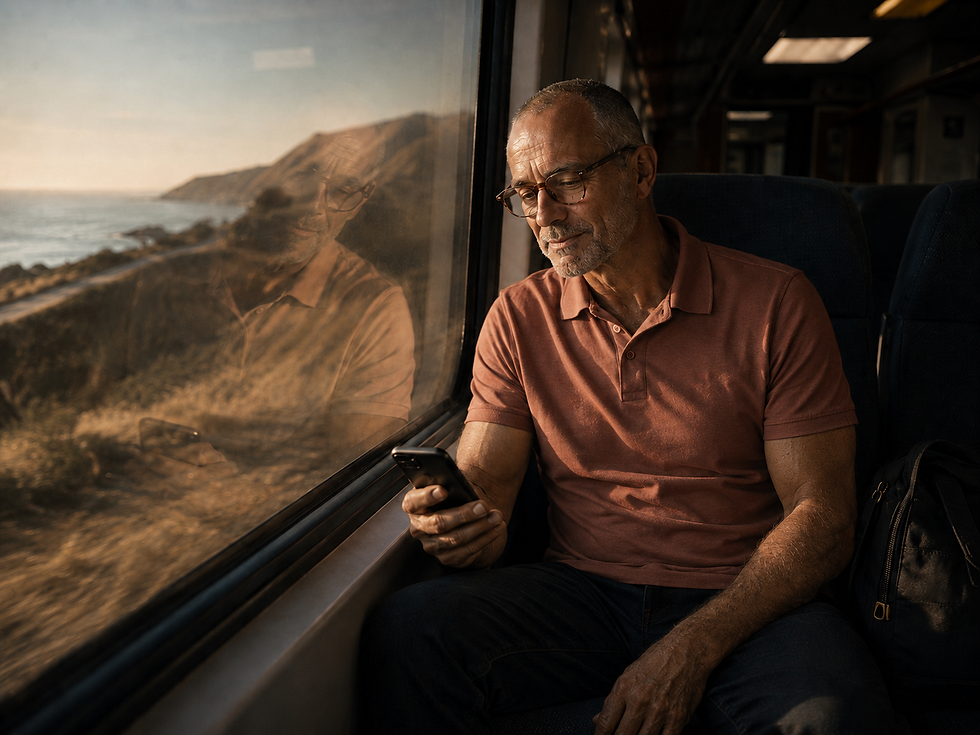
A second shower brings him halfway back to life. He dresses in dark jeans, a muted terracotta polo shirt, and comfortable shoes, packs a small overnight bag, and leaves the rest of his things in the hotel room.
The uniform hanging near the window makes the whole plan feel slightly illicit.
Not wrong. Just separate from the life that brought him here.
He takes a car to the station, finds the correct platform, and buys coffee that confirms Jack’s worst opinions about public transport.
The train arrives only a few minutes late.
Adrian settles into a window seat with his bag beside him and Jack’s directions saved on his phone.
Once the city begins to fall away, he allows himself to breathe.
The landscape changes gradually. Buildings thin out. Roads stretch farther between towns. Dry hills replace the dense edges of the city, the late-afternoon light turning them pale gold.
Adrian watches everything.
He has crossed oceans for most of his adult life, but usually from the sealed distance of an aircraft window. This feels different. Slower. More intimate. California passing close enough to study.
He sends Jack a message. On the train.
The reply comes several minutes later. Good.
Then: You still awake?
Adrian looks around the carriage.
A woman across the aisle is reading. Two students several rows ahead are sharing headphones. An older man is asleep with his mouth open.
Mostly.
The typing indicator appears. Disappears. Appears again.
Stay that way. I want you conscious when I kiss you.
Adrian stares at the screen.
Heat moves through him with embarrassing speed.
He reads the message again, then locks the phone and looks determinedly out of the window.
His reflection in the glass shows the beginning of a smile he cannot hide.
He writes: That seems unnecessarily demanding.
Jack replies: You’ll manage.
Adrian places the phone on the table and leaves it there.
For almost twenty minutes.
Then he picks it up again. How far are you?
Two hours.
From the station?
From you.
Adrian’s chest tightens.
It is not a romantic sentence. Not intentionally. Jack is simply stating the distance.
It still feels like one.
The train continues south.
Adrian dozes briefly, waking when his head tips toward the window. He eats the sandwich he bought at the station, drinks some water, and watches the sun sink gradually across the hills.
Every so often, Jack sends a message.
Nothing elaborate. Traffic’s clear.
Later: Mike has called twice. Ignoring him.
And then: Hotel confirmed. Sam says you’re welcome. Apparently she owns Cambria now.
Adrian replies: I look forward to meeting the local authorities.
The journey is shorter than it seemed when Jack first described it, though long enough for anticipation to become almost physical.
With every station announcement, Adrian becomes more alert.
He checks the map. Checks the time. Checks his reflection in the darkening glass and immediately feels ridiculous for doing so.
He is fifty-seven years old, tired after a transatlantic duty, and sitting on a train across California to meet a man nine years younger whom he has known for less than two weeks.
The sensible part of him should have more to say about this.
Instead, he wonders whether Jack will be wearing the olive-green T-shirt.
The thought takes him back to the workshop. Jack standing in the doorway, broad and entirely unaware of what his presence had done to Adrian’s ability to think.
Except Jack is not unaware now.
That has changed.
Jack could have someone younger. Someone local. Someone who does not arrive with a roster, a time difference, and a return ticket.
For a moment, the journey feels absurdly complicated.
Then his phone vibrates. I’m here.
Adrian looks at the words.
No complaint about the drive. No reminder of the work left behind. No suggestion that Adrian owes him anything for the effort.
Simply: I’m here.
The uncertainty does not disappear completely.
But it becomes quieter.
The train begins to slow.
The announcement names Paso Robles.
Adrian stands, lifts his bag from the rack, and moves toward the door with several other passengers. His body feels heavy from the flight and broken sleep, but beneath the fatigue is an energy that has nothing to do with rest.
The doors open.
Warm late-afternoon air enters the carriage.
Adrian steps down onto the platform.
For a second, he sees only the small station building, a few waiting passengers, and the cars beyond the tracks.
Then he sees Jack.
He is standing near the far end of the platform in jeans and a dark olive-green T-shirt, one hand resting against his hip. He looks larger than Adrian remembers.
Jack sees him at the same moment.
His whole face opens up — the guarded, waiting look gone in an instant, replaced by something that looks almost like relief.
He does not wait beside the truck.
He starts walking toward Adrian.
Adrian takes one step. Then another.
Jack reaches him before he can take a third.
He takes the bag from Adrian’s hand and sets it on the platform. One large hand closes around the back of Adrian’s neck.
“Hi,” Adrian manages.
“Hi.”
Jack pulls him in and kisses him.
There is nothing hesitant in it.
Jack’s mouth finds his with the certainty of a man who has spent hours driving toward exactly this moment.
Adrian’s hands close around Jack’s waist.
The station, the train, and every mile between San Francisco and Los Angeles fall away.
When Jack finally draws back, he keeps his hand at Adrian’s neck, his thumb moving once beneath Adrian’s ear.
“You stayed awake,” he says.
“Barely.”
“Good enough.”
Adrian looks past him toward the truck. “Where are we going?”
Jack picks up his bag. “Cambria.”
“What’s in Cambria?”
Jack looks at him.
“Us. For the next two nights.”


Comments